


Stop Looking for Notes. Start Hearing Where the Music Can Go.
Knowing more isn’t always the answer.
You can know your scales, chord tones, arpeggios, theory, and fretboard and still find yourself blanking out when it’s time to actually play. I’ve experienced this myself.
Improvisation asks for something different than memorizing and performing a part. It requires less mental processing and faster access to the sounds you’re hearing in your head.
Start with something you can see. Hear a possibility inside it. Give the idea a destination. And then the fun part… keep it moving before the moment is gone.
That’s what this library is built around.
Shape → Statement → Movement
Shape gives you something usable.
Statement turns it into a musical idea.
Movement lets the idea continue.
And underneath all three is Internalize — the process of making what you practice available when you actually need it.
You don’t have to move through these sections in order. Start with the problem that feels most familiar right now.
If the fretboard feels like a collection of disconnected notes, start with Shape.
If you know scales and patterns but your lines don’t sound melodic, start with Statement.
If your ideas stop every time the chord changes, start with Movement.
If you can do these things in practice but lose access when the music starts, start with Internalize.
1. Shape — Find Something You Can Use
You don’t need the whole fretboard at once.
A shape gives your fingers, eyes, and ears something concrete to work with.
Triads. Arpeggios. Pentatonics. Chord voicings. Scale fragments. Intervals.
The goal isn’t to collect more patterns.
The goal is to see a structure clearly enough that you can hear possibilities inside it.
Once a shape becomes familiar, the fretboard starts feeling less like dozens of notes you have to calculate and more like a collection of musical places you already know how to reach.
Start here:
Explore Shape:
- Bass Guitar Notes: Fretboard Charts for 4, 5 & 6-String Bass
- Bass Guitar Basics: The Structured Roadmap Self-Taught Players Actually Need
- Number System in Music (Simple Explanation for Beginners)
- Enharmonic Notes on Bass Guitar: Same Fret, Two Names
- What Are Arpeggios? And How To Use Them In Your Bass Fills
- Play Bass Guitar Arpeggios (The Easy Way For Beginners)
- Beginner Bass Chords on 4-String Bass Guitar (Complete Guide)
- What is “Chord Voicing”? Learn 2 Jazz Chord Voicings!
- Drop 2 Chords (My Favorite Jazz Chord Voicing For The Bass)
- What Are Pentatonic Scales? And How To Use Them In Solos
- Modes in Music: What Are They & When Should You Use Them?
- Stop Learning Scales as a Whole — Break Them Apart
- Best Way To Practice Scales Musically On Bass Guitar
- One Diminished Shape to Rule Them All: Unlocking Your 7th Chords
- How to Use the Circle of Fifths: A Practical Guide for Self-Taught Players
Want the Fretboard to Feel Less Like a Map You Have to Calculate?
Learn Your Fretboard Fast! is my structured course for building faster access to the notes and relationships across the bass.
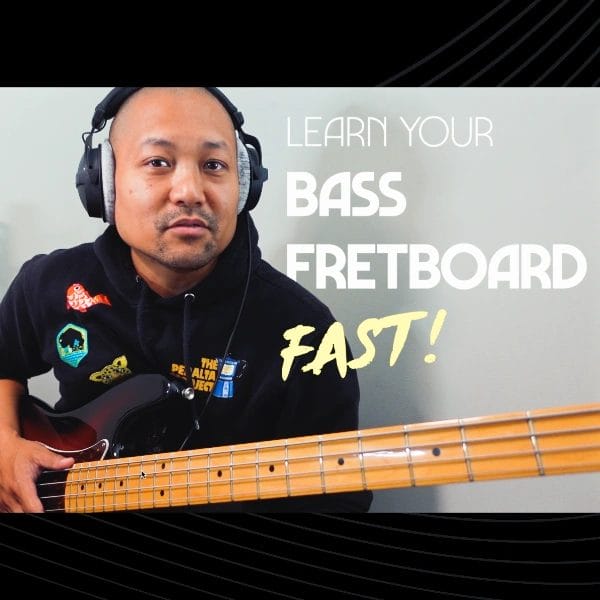
The goal isn’t simply being able to name every fret.
It’s making the fretboard familiar enough that finding the sound you’re hearing becomes easier.
2. Statement — Turn the Shape Into Music
A scale tells you which notes are available. It doesn’t tell you what to say.
This is where structure becomes a musical idea.
Instead of asking:
“What notes can I play?”
start asking:
“Where does this line want to go?”
A statement has direction.
There is a starting point, a destination, and a path between them.
Target notes, phrasing, articulation, tension, release, repetition, space, variation, and rhythm all help turn a familiar shape into something that actually sounds like music.
The goal isn’t to abandon the shapes you already know.
It’s to stop treating the shape as the finished product.
Start here:
Explore Statement:
- The Scale Isn’t the Goal. The Sound Is.
- Why Scales Don’t Teach You How To Improvise (But Phrases Do)
- Make Your Bass Solos Melodic (Stop Sounding Like Scales)
- Tonic Gravity: How to Play Any Note and Still Sound Good
- How One Bass Phrase Can Turn Into Many Pieces of Vocabulary
- How to Build a Vocabulary of Musical Phrases
- How Learning the Melody Makes Soloing 10× Easier
- How To Create Bass Fills (Step-By-Step Method For Beginner)
- I Used to Overcomplicate Every Tune. This Time, I Didn’t.
- 15 Chord Melody Arrangement Techniques For Solo Bass
- What Art Fundamentals Taught Me About Developing Musical Fluency
3. Movement — Keep the Idea Going
The line doesn’t have to end when the chord changes.
This is where improvisation starts feeling less like a series of separate decisions.
You play something.
The harmony moves.
Instead of throwing the idea away and searching for something new, you listen for where the material you already have can go next.
You don’t always need a new idea for the next chord. Sometimes the most musical thing you can do is discover where the idea you already have wants to go.
Maybe one note pulls toward another.
Maybe the same shape appears in a new inversion.
Maybe a destination becomes the beginning of the next statement.
Maybe tension simply wants to resolve.
Movement is what lets one musical thought become another.
Start here:
Explore Movement:
- How to Use Triad Pairs Without Memorizing Two Triads
- How To Use Triad Pairs To Create Movement In Your Solos
- Guide Tones – The Key To Melodic Direction In Your Solos
- Breaking Old Habits on the Bass: New Ways to Land on the Tonic
- The Diminished Chord Is a Magnet for Resolution
- Augmented Triad on Bass: How “Wrong Notes” Create Movement and Color
- Elevate Your Music With This Diminished Sound Exercise
- Contrary Motion in Music: All 5 Types Explained with Examples
- 4 Melodic Minor Modes You Can Use On V Chords (For Solos)
- 12 Essential Jazz Scales & How To Connect Them
- How To Solo Over Rhythm Changes (The Easiest Way)
- How To Play A Walking Bass Line: A Fundamental Guide
- From Switching to Landing: How I Practice Clean Chord Changes
- How I Learned the Chord Changes to Smashing Pumpkins “Tonight, Tonight” by Ear
Ready to Go From Shape to Statement to Movement?
Knowing the shape is only the beginning.
Shape to Statement is my course about turning familiar structures into melodic ideas you can actually use — and learning how to keep those ideas moving through harmony.

You’ll work with shapes, destinations, connectors, inversions, harmonic movement, and the process I use to turn something familiar under my fingers into an actual musical statement.
The goal isn’t more information.
It’s faster access to musical possibilities you can hear and use in real time.
4. Internalize — Make It Available When You Need It
Understanding something isn’t the same as having access to it.
You can understand a phrase.
You can play it slowly.
You can analyze every note.
You can even play it perfectly during practice.
And then the music starts — and it’s gone.
Internalization is the process of closing that gap.
It isn’t really the fourth step after Shape, Statement, and Movement.
It’s what makes all three increasingly available without conscious effort.
Instead of trying to memorize more information, you repeatedly hear, sing, retrieve, move, manipulate, and reconnect with musical material until it becomes familiar enough to show up when you need it.
This is where ear training, transcription, chunking, repetition, retrieval, and practice design come together.
The goal is simple:
Less searching. Less remembering. Less calculating. More access.
Start here:
Explore Internalize:
- Why Some Musicians Sound Fluent
- You Don’t Need an Hour to Build Your Musical Vocabulary
- I Learned Music Backwards (Here’s the Practice Method I Wish I Started With)
- Why Traditional Ear Training Apps Don’t Work (And What Actually Does)
- You Trained the Wrong Coordination. Here’s What to Do Instead.
- Change the Key Before You Get Comfortable: An Ear-First Bass Practice Tip
- How I Practice Shapes on the Bass and Internalize Faster
- How to Use a Drone to Help You Feel the Root Note (Homebase)
- How to Train Your Ear Without Extra Practice Time (Using Spotify’s Mix Feature)
- Why Isolation Can Hurt Your Playing (Unless You Do This)
- I Built a Tool to Help Sounds Actually Stick
- Sentence Pyramids — But for Learning Music (Music Phrase Pyramids Walkthrough)
- The Unexciting Truth About Transcribing Music
- How to Transcribe Bass Solos (And Internalize Them): My Step-by-Step Workflow & Tools To Get The Most Out Of Each Note
- How to Transcribe Jazz Solos (Without Losing the Music)
- How to Practice Transcription on Bass (Without Burning Out)
- How To Transcribe Music Effectively and More Often
Capture. Chunk. Practice.
Music Phrase Pyramids
One of the hardest parts of learning music by ear isn’t finding a good phrase.
It’s getting that phrase to stay with you.
Music Phrase Pyramids is an iPhone, iPad, and Mac app I built around progressive chunking: break a phrase into smaller pieces, learn those pieces deeply, and gradually rebuild the complete musical idea.

Instead of endlessly replaying the same difficult section and hoping it sticks, you work with smaller chunks your ears and hands can actually retain.
It’s designed for transcription, phrase learning, ear training, and turning recordings you love into vocabulary you can eventually make your own.
Want to see how I use it?
- I Built a Tool to Help Sounds Actually Stick
- Sentence Pyramids — But for Learning Music (Music Phrase Pyramids Walkthrough)
- I’ve been gone for a month. Here’s what I’ve been working on.
- Music Phrase Pyramids Version 2 Is Here
Go Deeper by Topic
The framework above is the best place to start if you’re trying to solve a playing problem.
If you’re looking for something specific, you can also browse the site by topic.
Musical Vocabulary
Phrases, melodic ideas, improvisation, fluency, phrasing, and the process of turning familiar material into your own musical language.
Fretboard & Notes
Notes, positions, fretboard relationships, visual patterns, and tools for seeing the instrument more clearly.
Jazz Harmony & Shapes
Triads, chord structures, voicings, intervals, harmonic movement, and ways of navigating changing harmony.
Technique & Groove
Time feel, articulation, note duration, physical technique, groove, accuracy, and the details that make a line feel good instead of merely correct.
Bass Fundamentals
The foundational concepts that support everything else: notes, rhythm, chords, scales, arpeggios, technique, and basic musicianship.
Creative Life & Tools
Practice habits, creative process, useful software, experiments, reflections, and tools that make learning or creating a little easier.
Gear Reviews
Bass gear I’ve actually used, along with practical observations from the perspective of a working player.