If You’ve Done Ear Training… But Still Can’t Play What You Hear
If you’ve spent time doing ear training (i.e. interval drills, chord recognition, scale identification) you’ve probably experienced this:
Your ability to identify sounds improves… but your playing doesn’t feel any more musical.
I’ve been there.
At one point, I spent months doing daily ear training while recovering from a hand injury. I couldn’t play much, so I focused heavily on my ears. Apps, drills, exercises.
I did all of it.
And it worked… to a point.
I got better at recognizing intervals. I could hear chord qualities more clearly.
But when I picked up the bass again, something was off.
I still didn’t feel like I could use what I was hearing.
Why doesn’t ear training work?
Ear training often doesn’t work because it focuses on recognizing isolated sounds instead of developing real musical response. Most methods train you to identify intervals and chords, but not to retain phrases, recall them, and play them naturally in context. So while your ear improves, your ability to actually make music stays the same.
The 4 biggest reasons ear training breaks down
- It trains recognition more than recall
- It removes sound from musical context
- It doesn’t build phrase vocabulary
- It creates a gap between your ear and your hands
What is the most effective ear training method?
The most effective ear training method combines listening, imitation, repetition, and phrase-based learning. The key is working with real musical material instead of isolated drills, so your ear develops retention, recall, and expression—not just recognition.
Why does ear training feel hard?
Ear training feels hard because many methods don’t match how people naturally learn sound. When training is isolated, abstract, and disconnected from real music, progress feels slow. Phrase-based learning and progressive chunking make ear training feel more intuitive and musical.
The Real Reason Ear Training Doesn’t Work
The problem isn’t that ear training doesn’t work.
It’s that:
Most ear training trains the wrong skill.
Traditional ear training is built around recognition:
- identifying intervals
- naming chord qualities
- distinguishing scales
But music doesn’t happen at recognition.
It happens at response.
More specifically:
It happens when you can hear something… retain it… and then express it on your instrument in real time.
And that’s where most approaches fall apart.
What “Traditional Ear Training” Actually Trains
When I say “traditional ear training,” I’m talking about the kind of training most apps and programs focus on:
- Interval recognition
- Chord identification
- Scale and mode detection
- Dictation exercises
These are all valuable skills.
But they share a common structure:
You hear something → you analyze it → you label it.
While that process builds awareness, it also creates a subtle habit: You start relating to sound through translation instead of direct understanding.
And that becomes a problem when you try to make music in real time.
Why Traditional Ear Training Breaks Down in Real Music
1. It Trains Recognition, Not Recall
Recognition is passive.
You hear something and say, “That’s a minor third.”
But in music, you don’t need to recognize a sound.
You just need to remember it and respond to it instantly.
Those are two completely different skills.
And most ear training never bridges that gap.
2. It Removes Musical Context
Most drills isolate sound.
A single interval. A single chord. A single scale. It’s a clean, controlled example.
But real music is never isolated.
It’s:
- moving
- contextual
- shaped by what came before
So when you train your ear in isolation, you’re not actually training it for how music behaves in real situations.
3. It Doesn’t Build Phrase Vocabulary
This was one of the biggest gaps I didn’t understand for years.
I knew theory. I had technique. I could identify sounds.
But I didn’t have phrase vocabulary.
In other words, I didn’t have a collection of musical ideas that I could hear, recognize, and immediately express.
So instead, I would manufacture lines using theory.
And no matter how “correct” they were… something always felt missing.
4. It Creates a “Middleman” Between Your Ear and Your Hands
This is where everything finally clicked for me.
When I improvised, I started noticing something:
I would hear an idea… but instead of responding naturally (like when I’m just speaking and having a conversation), my mind would step in and translate it.
It went something like this: “Okay, that sounded like a major third… maybe I can follow it with…”
That translation process became a kind of middleman between what I heard and what I played.
And that delay (even if it was small) was enough to break the musical moment and feel disconnected.
Because music doesn’t wait for you to analyze it.
It moves.
And if your response depends on translation, you’re always just a step behind.
Music Is Learned Like Language—Not Like Flashcards
I didn’t fully understand what was missing until I saw it outside of music.
A few years ago, I was teaching my child how to read and speak.
We used something called sentence pyramids. You start with a small phrase, then gradually expanding it step by step into a full sentence.

What stood out to me wasn’t just that she learned to read.
It was how naturally her vocabulary developed.
She wasn’t memorizing grammar rules.
She wasn’t analyzing sentence structure.
She was absorbing language through phrases.
And over time, she could:
- recognize patterns
- tell stories
- express ideas
All without ever needing to consciously think about grammar.
That’s when it clicked for me:
Music works the same way.
Vocabulary comes before grammar.
Research in language acquisition shows that humans learn best through meaningful chunks of information rather than isolated elements.
The Step Most Ear Training Skips
Looking back at my own training, I realized something important:
I didn’t lack knowledge.
I lacked musical vocabulary.
Not scale vocabulary.
Not theoretical vocabulary.
Phrase vocabulary—the kind you can:
- hear
- remember
- sing
- and actually play (in multiple contexts)
Most ear training builds recognition.
But it skips what comes next:
Retention → Recall → Expression
That’s the missing step.
Because recognizing a sound once doesn’t mean you can:
- remember it
- reuse it
- or respond to it musically
And that’s exactly where the gap between your ear and your instrument lives.

If this gap sounds familiar, you’re not alone.
Most ear training stops at recognition. But the real shift happens when you start retaining and reusing what you hear.
How Musical Hearing Actually Develops
When you strip everything down, musical hearing develops in a sequence that looks more like this:
Hear → Retain → Recall → Express
Not:
Hear → Analyze → Label
That shift changes everything.
Because instead of translating sound into theory (analyzing and labeling)… You start relating to sound as something you can keep and reuse.
This was the turning point for me.
Before, I would think things like:
“Play a major third… then a descending scale… maybe resolve with a chromatic enclosure…”
Now, I hear a phrase, and I want to play that phrase.
There’s no middleman.
Just sound → response.
And the more this connection develops, the more your playing starts to feel like something that’s coming from you, not something you’re constructing in real time.
Not All Ear Training Apps Are the Same
Once you see this clearly, you start to notice something:
Not all ear training apps are trying to solve the same problem.
They generally fall into three categories:
1. Drill-Based Training (Recognition)
These apps focus on:
- intervals
- chords
- scales
- dictation
They’re great for building awareness and fundamentals.
But they mostly train recognition, instead of real-time musical response.
2. Response-Based Training (Call and Response)
These approaches move closer to music.
You hear something → you play it back.
This develops:
- imitation
- phrasing awareness
- musical reflexes
It’s a big step forward.
But it still doesn’t always address retention over time or building a reusable vocabulary.
3. Phrase-Based Training (Retention + Expression)
This is the missing layer.
Instead of just hearing and reacting…
You:
- break phrases into manageable pieces
- internalize them
- rebuild them
- and turn them into vocabulary you can actually use
This is where ear training starts to translate into real playing.
If you’re looking for a breakdown of specific tools, see my full guide to the best ear training apps.
The Type of Training That Actually Bridges the Gap
This is the gap I kept running into, both in my own playing and in the musicians I worked with.
Not a lack of knowledge.
Not a lack of effort.
But a lack of a system for internalizing and retaining real musical ideas.
So I started experimenting with a different approach.
Instead of practicing entire phrases all at once, I broke them down into small, manageable chunks, just like a sentence pyramid, and gradually expanded them.
That process became the foundation for something I now call: progressive chunking
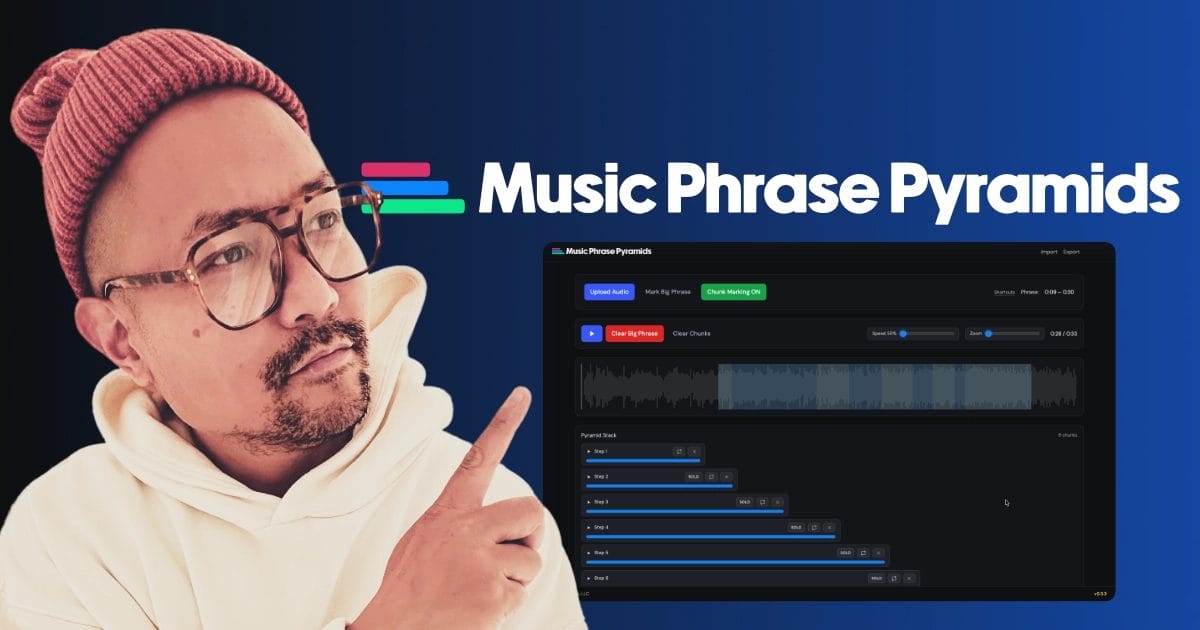
Music Phrase Pyramids (Phrase-Based Ear Training)

Music Phrase Pyramids is built around this exact idea.
It’s essentially sentence pyramids for music.
You start with a small piece of a phrase.
Then you expand it step by step, like building a pyramid, until the entire phrase becomes something you can:
- hear clearly
- remember
- and play back naturally
Because the brain isn’t overwhelmed, it starts to internalize the sound much faster.
Over time, a few things start to happen:
- your phrase vocabulary grows
- your melodic retention improves
- your ability to hear longer ideas expands
- and most importantly…
- the gap between your ear and your hands starts to close
This is the shift I’ve been experiencing in my own playing:
- Before: I was constructing lines.
- Now: I’m hearing ideas, and responding to them.
The music feels less manufactured and more like something I’m actually saying.

If you want to experience this approach directly:
Music Phrase Pyramids gives you a structured way to turn phrases into real, playable vocabulary—step by step.
Where Most Apps Fit (And Where They Don’t)
Once you understand these categories, it becomes easier to see how different tools fit together:
| App | Strengths |
|---|---|
| EarMaster | great for building foundational skills and awareness |
| ReelEar | strong for call-and-response and musical interaction |
| Music Phrase Pyramids | designed specifically for retention, vocabulary, nuance, and expression |
Each one serves a different role.
But if your goal is to play what you hear, you need to go beyond recognition.
You need a way to turn sound into something you can actually keep and use.
Common Questions About Ear Training
How long does it take to improve your ear?
Most musicians notice improvement within a few weeks of consistent practice.
But meaningful progress depends on what you’re training.
Recognition improves quickly. But, musical fluency takes longer, because it involves retention, recall, and expression.
What is the most effective ear training method?
The most effective method combines:
– listening
– imitation
– repetition
– and phrase-based learning
The key is working with real musical material, not just isolated sounds.
Can you train your ears at any stage?
Yes. Your ear continues to develop as long as you engage with sound intentionally. In many cases, the issue isn’t ability, it’s the approach.
Why does ear training feel hard?
Because most methods don’t align with how we naturally learn sound.
When you shift toward phrase-based learning and progressive chunking, things tend to feel much more intuitive.
The Goal Isn’t to Hear More—It’s to Say Something Back
For a long time, I thought ear training meant learning to identify sounds.
And while that’s part of it, it’s not the part that makes you musical.
The real goal is simpler and more challenging at the same time:
To hear something and be able to say it back. Without translation. Without hesitation.
That’s when music stops being something you construct and starts becoming something you speak.

If your goal is to play what you hear—not just recognize it—
then your training needs to move beyond drills and into real musical language.