


Bassist, educator, and creator exploring a clearer, more ear-first path to musicianship.
I didn’t grow up dreaming of being a bass player. In 1995, I wanted to play guitar. But my brother, already a drummer with opinions, said, “Play the bass instead.”
Little did I know, this would be one of the best decisions of my life.
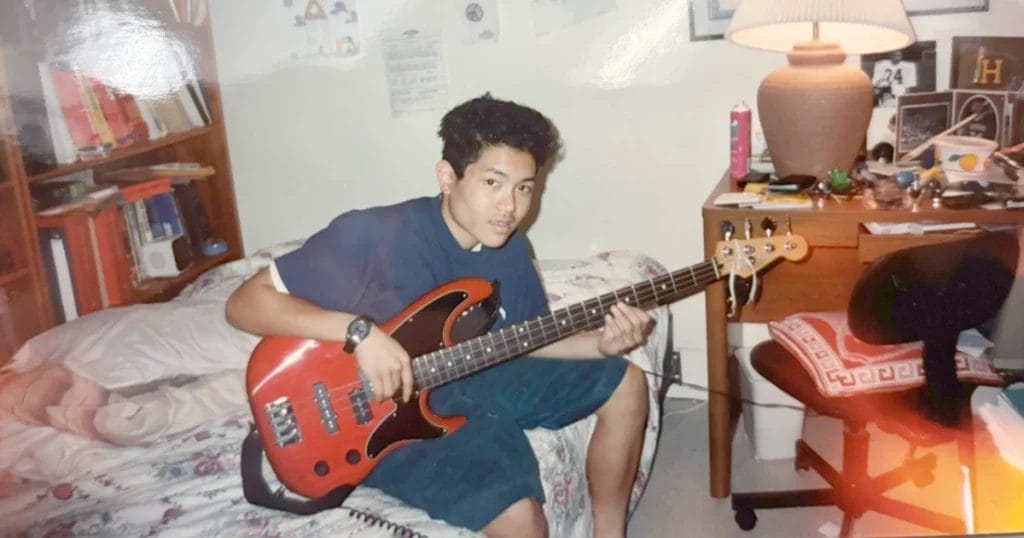
From the first moment I plucked a string I fell in love with the sound and I became obsessed.
Soon I was deep into funk and rock, playing in bands, rehearsing in garages, and performing locally.
Then my brother played me a tune from Chick Corea Akoustic Band. I still remember the tune. It was a live recording of On Green Dolphin Street.
My ears were immediately drawn to the drum rhythms of Dave Weckl and the dynamic bass lines of John Patitucci. Suddenly the bass felt like an entirely different universe for me to explore.
But everything changed again in 1996, when a local bass player told me to check out The Aquarium Rescue Unit. They were coming to a club in Baltimore, MD.
That night I saw Oteil Burbridge perform for the first time.
I walked out speechless.
I had no idea the bass could be so melodic, so harmonic, so rhythmically alive. That performance reshaped my understanding of the instrument and set the course for everything that came after.
The Life Shift I Didn’t Expect
For nearly 15 years, I traveled on the road and in the studio, playing in clubs, festivals, living room shows, doing recordings, whatever the gig required.

I played constantly, performed constantly, learned constantly. It was a beautiful, chaotic, deeply musical season of life.
But it also came with physical strain. I eventually developed tendonitis, and in 2014, I took a job in IT to bring more stability into my life. One thing led to another, and I found myself fascinated with scripting, automation, web development, and eventually AI.
I was making more money than I ever had as a musician…
but I was also working 60+ hours a week.
The bass slowly drifted into the background.
What used to be daily practice became “maybe once this week.”
Then in 2020, I became a parent. Talk about a life-altering shift that left me with even less time, and far less energy.
Weeks would go by without touching my bass. My chops disappeared. And for the first time in my life, I felt genuinely disconnected from my instrument.
Relearning the Bass — and Relearning Myself
Something had to change.
If I was going to continue playing, it couldn’t be the way I played in my twenties.
I had to find a way to feel connected again.
Watching my child learn to speak was unexpectedly profound. She wasn’t reading syllables or reciting grammar rules. She was listening, imitating, responding, exploring. Everything was ear-first.
That changed how I saw music.
I realized that in my earlier years, even though I had chops and technique, I wasn’t always hearing what I was playing.
I was always an intuitive player and often would surprise myself at something I played that sounded cool. But I wasn’t always speaking from the inside out.
So I began relearning the bass with a single guiding belief:
Music begins with your ear, not your fingers.
I shifted from chasing technique to chasing sound. From mental gymnastics to musical intuition. From “What scale works over this chord?” to “What do I hear next?”
And with limited time, limited energy, and a lingering injury, clarity and simplicity became essential.
The Teachers Who Showed Me What Musical Freedom Looks Like
Around this time, I started paying closer attention to musicians who played with a kind of effortless freedom — not because of flashy technique, but because their ear and hands were always seemed to be in sync.
Players like:
- Oteil Burbridge
- Barry Harris
- Joe Pass
Each had their own sophistication, but also a simplicity that felt deeply musical. They taught me that freedom doesn’t come from more information. It comes from removing friction, strengthening your ear, and trusting your intuition.
This became the foundation of my entire teaching philosophy.
Where I Am Today
Today, I see myself as:
- an educator,
- a bassist rediscovering his voice, and
- a guide-in-progress for anyone walking a similar path.
My ideal students are:
- players returning to their instrument after a life transition,
- musicians who want to improvise but don’t know where to begin, and
- bassists who feel stuck in theory and find themselves overthinking every note.
If that’s you — you’re in the right place.
Everything I create — lessons, tools, courses, videos — is designed to help you feel:
- more confident,
- more connected, and
- more free every time you pick up your bass.
Beyond the Bass
Outside of music and tech, I’m a parent navigating the beautiful chaos of raising a child. I tinker with creative projects — a children’s book, a mindset app, dabbling in chess — and I’m often (too often) distracted by learning new card tricks.
Curiosity has always been my north star.
My values are simple:
- stay curious, and
- follow your highest excitement and joy.
These values guide my musicianship, my teaching, and the way I build tools for others.
An Invitation
If any part of my story resonates with yours — if you’re returning to your instrument, searching for clarity, or trying to play in a way that feels free and musical — I’d love to support you on that journey.
Start with my lessons and see what speaks to you.
They’re written for players just like you — and just like the version of me that needed them most.