


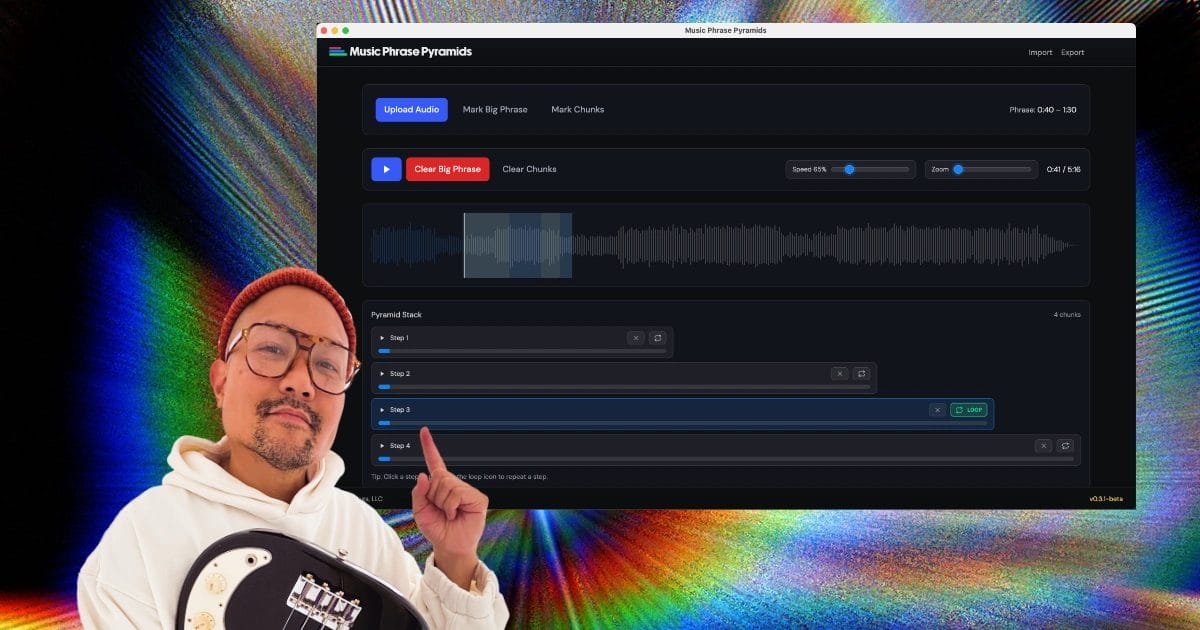

When I taught my daughter to read at a young age, I used a technique called sentence pyramids.
Instead of showing her full sentence, I revealed it progressively: one word, then two words, then three, then four — and so on until the full sentence appears.
Each step built on the previous one.
And I even applied this applied to phonemes to teach a her how to recognize words.
The key idea was this: She didn’t memorize isolated letters. Instead, she absorbed larger chunks and phrases.
But what fascinated me most was this: I never explicitly taught her grammar. Yet she began speaking and constructing complex sentences naturally, even to the point where she could make up and tell her own stories.
And I believe it’s because she learned chunks of language more than by learning the letters individually.
Related: Why Ear Training Doesn’t Work
My playing lacked story
For more than two decades, I’ve played the bass. During that time, I toured, played gigs, learned theory, and practiced scales, modes, arpeggios, and understood chord-scale relationships.
I’ve played cool things on the instrument and made music with some amazing musicians.
But there was always something I quietly noticed.
Some musicians, when they soloed, sounded like they were telling a story.
Their phrases had shape, direction, meaning, continuity, and contour.
And as embarrassing as it is to say, my playing often didn’t.
I had chops. My time was solid. I knew how to apply a lot of melodic concepts. But my lines lacked story.
And for the longest time, I couldn’t quite explain why. But I could at the very least intuit that telling a story musically was something far more than just applying theory.
My realization: I learned music backwards
Like many musicians, I learned music from the inside out.
I started my learning with major and pentatonic scales. Then came modes. Then chord-scale theory. And then embellishments like approach notes, enclosures, and extensions.
In other words, I learned the notes and concepts (grammar) before I learned the language (vocabulary).
And while I got pretty far this way, I eventually hit a ceiling.
Music, at its core, is a language. And humans don’t learn language by memorizing letters. We learn language through phrases.
My daughter didn’t start by studying grammar. She started by hearin