


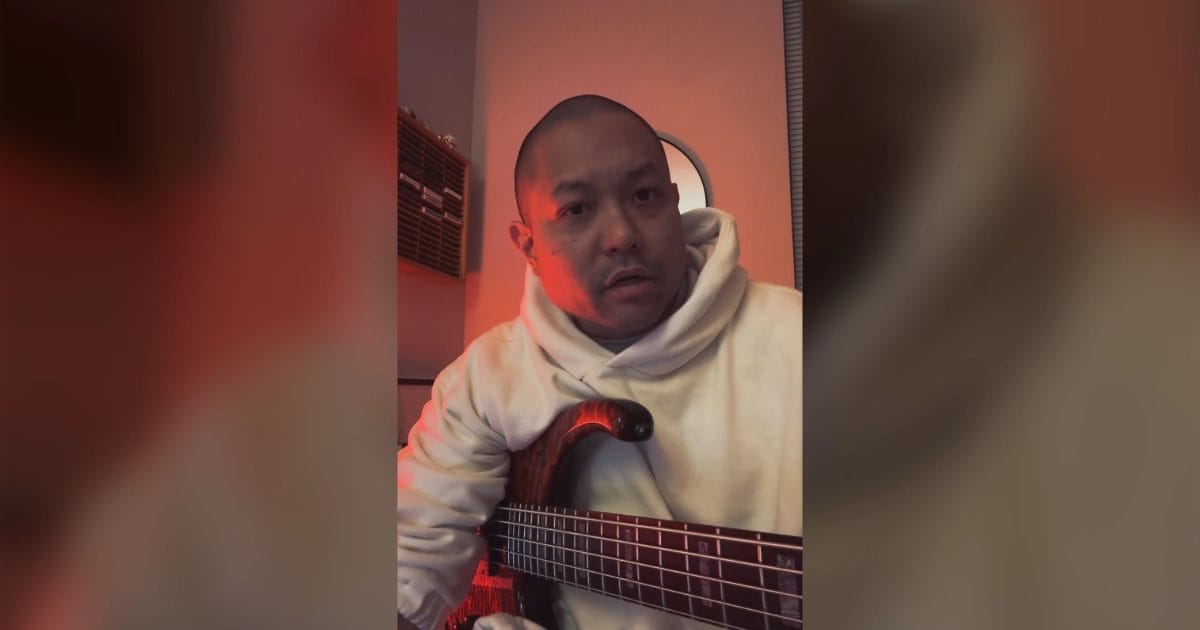

I spent years getting better at playing when I could see my hands. Turns out I was solving the wrong problem entirely.
I was working on transcribing a Jimmy Herring guitar solo. Playing along, finding the notes, feeling pretty good about it — until I looked away from my hands.
Everything fell apart.
Not just a little off. Completely unreliable. I’d lose the phrase, miss the position, fumble through notes I’d been playing cleanly moments before. So I did what any reasonable musician would do: I looked back at my hands. And immediately, the accuracy came back.
That’s when it hit me. I hadn’t been training my ears to guide my hands. I’d been training my eyes to guide them.
“The real instrument is your ears — not your bass. Whatever weaknesses you have with your ear, that’s ultimately gonna show up in your playing.”
Eye-hand vs. ear-hand coordination
These are two fundamentally different skills — and most musicians, myself included, spend the majority of their practice time developing only one of them.
| What most of us train | What we should train |
|---|---|
| Eye-hand coordination ❌ | Ear-hand coordination ✅ |
| Your eyes confirm finger placement. Accuracy improves when you look. Falls apart when you don’t. Builds technique — but not internalization. | Your ears guide your hands. You can find the note before you see it. Works in the dark, on stage, in the moment. Builds true musicianship. |
Don’t get me wrong… Eye-hand coordination isn’t useless — it’s part of learning any physical instrument.
But if it becomes your primary guidance system, you’ve built a dependency. Your accuracy becomes conditional on something that won’t always be available: a clear sightline to your fretboard.
The question isn’t can you play it. The question is: can you still find it when your eyes aren’t looking?
How to start building ear-hand coordination
The fix is uncomfortable at first. But the good news is, it’s simple.
Transcribe without looking. Not occasionally. Repeatedly, over and over, until your ears become the support system your hands rely on.
- Pick a short phrase — four to eight notes from a solo or melody you’re working on. Something you can already play when looking.
- Close your eyes or look away. Play it. Notice where it breaks down — that’s exactly where your ear isn’t guiding your hand yet.
- Sing the phrase before you play it. Your voice is the most direct line between your ear and your musical intention. If you can’t sing it, you don’t hear it yet.
- Repeat the phrase without looking until the accuracy matches what you get with your eyes open. That’s when internalization is actually happening.
- Extend to longer passages — but only after the shorter chunk is fully internalized. Don’t rush the length; rush the listening.
This will feel slow and humbling. And it’ll suck. That’s the point. The messiness you hear when you look away isn’t a sign of failure — it’s an accurate picture of where your ears actually are. And now you know what to work on.
Most of us have been practicing the wrong thing in the wrong direction for years. But the correction isn’t complicated. It just requires looking away.
More on training your ear and fretboard awareness: Explore Fretboard & Notes →

Put This Into Practice
If you want to actually close the gap between what you hear and what you can play, you need a way to work with real musical phrases — not just concepts.
Music Phrase Pyramids is a tool I built to help with that.
It lets you take any audio and break it into progressive steps, so you can internalize, map, and build phrases in a structured way.