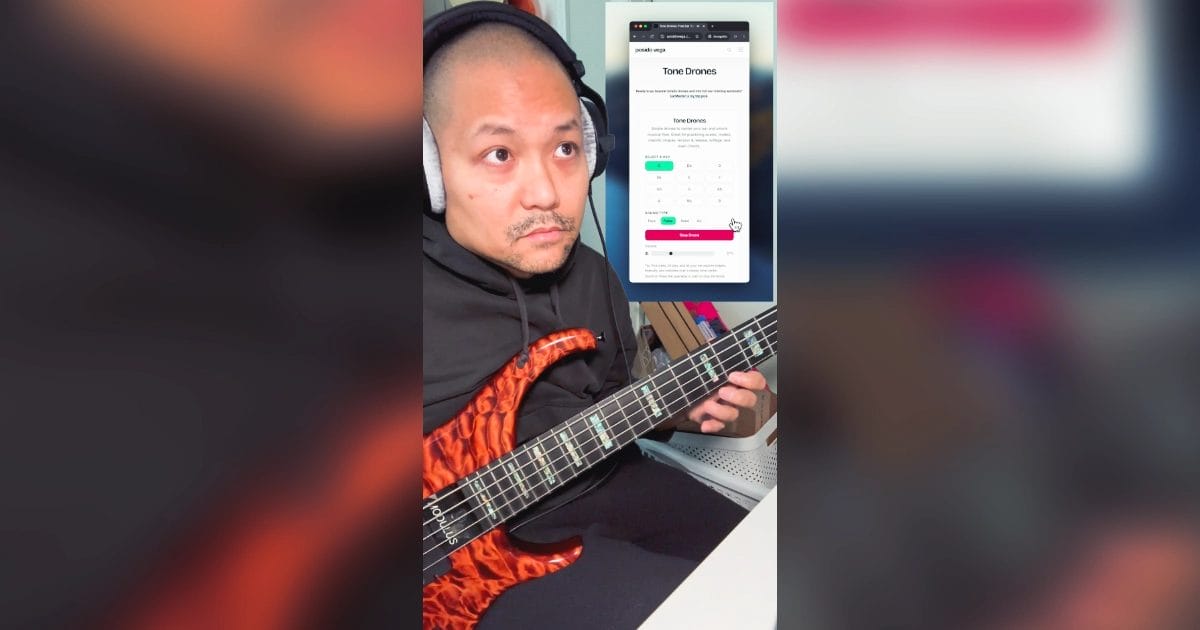
The simplest way to train your ear, understand tonal gravity, and develop true relative pitch.
Most musicians want to improve their ear, but one of the biggest hidden challenges is this:
They can’t reliably feel the root note — the “homebase” everything in the music pulls toward.
Without that sense of home, everything feels a little confusing:
- melodies feel disconnected
- chord progressions feel hazy
- improvisation feels like guesswork
- and tension never quite resolves the way you expect
But here’s the good news: Feeling the root is not about memorizing theory or naming every interval. It’s about hearing how a note behaves against a tonal center.
And there’s no tool better for that than a drone — a single sustained pitch that never moves.
A drone simplifies the entire musical world down to two things:
- Home (the root note)
- Everything else (how other notes feel against home)
Today, I’ll walk you through a simple ear-first, practical exercise to help you understand tonal gravity, feel interval tension, and develop your relative pitch in a way that finally makes harmony make sense.
Why Feeling the Root Note Matters
If you’ve ever gotten lost in a chord progression, struggled to hear when a melody resolves, or felt unsure about your note choices, it’s usually because the root note — the tonal center — isn’t clear in your ear.
The root is homebase.
It’s where:
- tension releases
- movement returns
- harmony feels grounded
- melodies feel complete
When you can hear home, you can instinctively feel:
- where notes want to go
- how close or far you are from resolution
- the emotional color of an interval
- whether a note is stable or unstable
- the direction of melodic movement
This is the foundation of relative pitch — not naming notes, but sensing their relationship to the root.
And a drone makes this unbelievably clear.
Why a Drone Helps You Hear the Root
A drone is simply a sustained tone — a constant root note humming underneath your playing.
With a drone:
- the key never changes
- the tonal center is always present
- your ear has a stable reference point
- every interval feels exaggerated
- tension and resolution become obvious
Suddenly, harmony stops feeling like an abstract concept and becomes something you can feel in your body.
Every Note Has a Feeling, Direction, and Pull
When you play a note against a drone, it immediately reveals its interval behavior:
1. Some notes want to resolve upward
These tend to feel bright, tense, or “lifting.” They pull you toward the next scale degree. The major 7 does that for me.
2. Some notes want to resolve downward
These feel heavier or more “falling.” They want to return home by dropping. For example, descending half-steps feel like I’m falling down the stairs. Then when I finally land on the root, it feels like I hit the very bottom of the stairs.
3. Some notes can resolve either direction
Their tension is flexible — it can lean up or down depending on context.
4. Some notes gravitate toward the third or fifth first
They don’t resolve straight to the root. Instead, they pass through key notes (like the 3rd or 5th) before arriving home. These notes feel like they don’t want to go home, just yet.
5. Some notes feel deeply unstable (like the tritone)
This type of tension always feels cinematic to me, makes me feel like I’m in a movie, and demand movement.
These behaviors are the essence of tonal gravity.
Once you feel these sensations, you start hearing:
- why melodies move the way they do
- why certain notes sound stable
- why some notes create tension
- how harmony works without thinking about it
This is harmony at its deepest and simplest level.
The Practical Exercise: How to Feel the Root Note Using a Drone
You can do this right now on bass, keyboard, guitar, or even by singing.
Step 1 — Start a drone
Pick a root note — C, E, D, whatever you like — and sustain it.
(A simple way to do this is with my Tone Drones tool, which lets you hold any note indefinitely.)
Step 2 — Play one note. Any note.
Don’t think about “right” or “wrong.”
You’re listening, not judging.
Step 3 — Hold it and notice how it feels
Ask yourself
- Is it stable?
- Is it tense?
- Is it bright?
- Is it heavy?
- Is it open?
- Does it feel like it wants to move?
Step 4 — Ask: “Where does this note want to go?”
Ask yourself,
- Does this note want to go up?
- Does this note want to go down?
- Does this note want to go either way?
- Does this note want to go through another note, like the third or fifth first?
Let the note guide you.
Step 5 — Follow the resolution
Move in the direction your ear is pulling you.
Notice how long it takes to return to homebase.
This is the root revealing itself.
Step 6 — Describe your feelings out loud
This is one of my favorite parts of the practice.
When I hit a tritone, for example, I often say: “It feels cinematic, like I’m in a movie.”
Describing your emotional reaction builds a strong aural memory and strengthens your tonal awareness.
Why This Exercise Improves Relative Pitch
Relative pitch isn’t memorization. It’s pattern recognition — in feeling, not just sound.
When you practice this way:
- intervals gain emotional signatures
- tension becomes familiar
- resolution feels predictable
- your ear begins to map the tonal center automatically
- hearing the root becomes second nature
You won’t need to search for “home.” You’ll feel it.
Try This Right Now: Tone Drones
To make this process easier, I built a simple tool called Tone Drones — a free online drone generator.

You can:
- sustain any root note
- practice intervals
- explore tension
- hear tonal gravity
- develop real melodic intuition
- train your ear without overthinking
It’s minimalist and made exactly for this kind of practice.
Final Thoughts — The Root Is Homebase
If harmony feels confusing, or if note choices feel random, don’t start with theory. Start with home.
This is how you learn to hear the root note — not by naming it, but by feeling it.
Want to go deeper into tension, resolution, and melodic movement? Explore more lessons inside my Jazz Harmony & Shapes category.
Frequently Asked Questions
How do I know if I’m actually hearing the root note?
You’ll know you’re hearing the root when the note feels like “home.” It’s the place where tension releases and everything settles. If a note feels stable, grounded, or complete when you land on it, that’s usually the root. Drone practice makes this feeling unmistakable because the tonal center never changes.
What note should I start with when practicing with a drone?
The actual note doesn’t matter as much as learning to hear how other notes behave against it — their tension, direction, and resolution.
How long should I hold each note when practicing?
Hold each note long enough to feel its interval tension and natural direction of resolution. The goal isn’t speed. It’s listening. Let the note fully reveal how it leans toward or away from the tonal center.
Will practicing with a drone help my relative pitch?
Absolutely. Drone practice strengthens your relative pitch because it trains you to hear notes in relation to the root. You start recognizing the emotional color of each interval — stable notes, unstable notes, tendency tones — which is the foundation of intuitive ear training.
Can I use this method to improve my improvisation?
Yes. When you can feel the root note and understand interval behavior, your improvisation becomes more intentional. Instead of guessing, you start choosing notes based on their tension, color, and direction. This leads to smoother melodic movement and more expressive phrasing.