


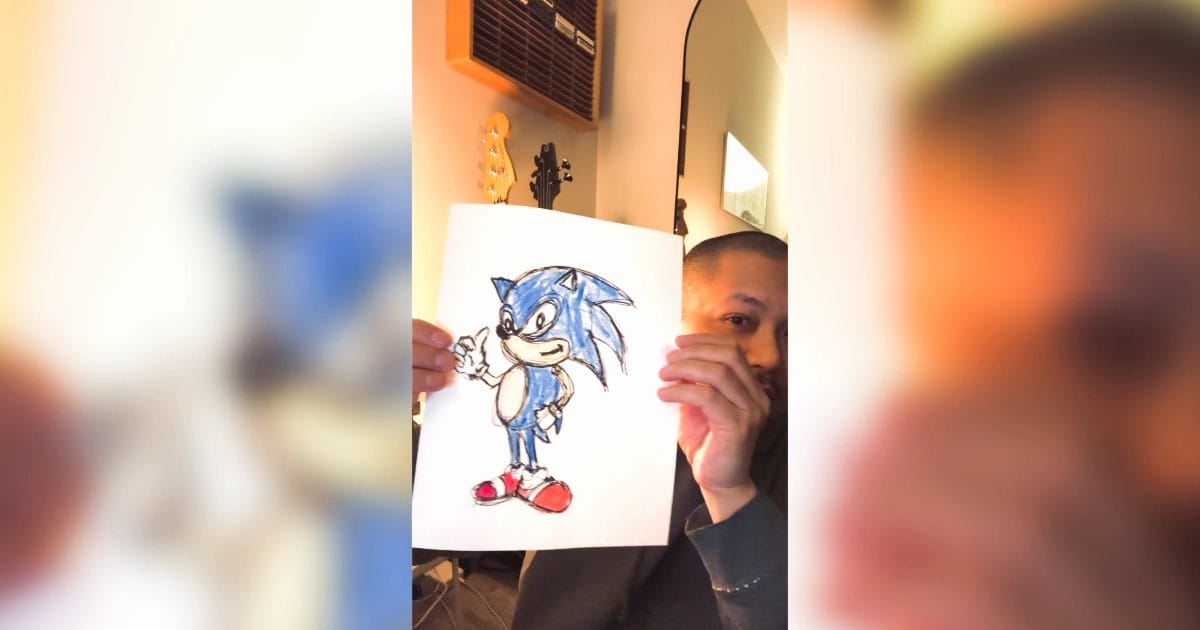

A few days ago, I did a drawing session with my daughter. We made it more fun by adding a simple restriction: we could draw characters from Sonic the Hedgehog, but each drawing had to be finished in under five minutes. We were allowed to look at the image, but we couldn’t linger. No perfection. No polishing. Just draw and move on.
What surprised me wasn’t how clean the drawings were. Some proportions were definitely off. But what stood out was how recognizable they still were. Sonic looked like Sonic. Knuckles looked like Knuckles. The essence was there.
That experience sparked a realization that carried far beyond drawing—and straight into how I think about music.
You Can Always Lean on the Fundamentals
I don’t really draw much anymore, and I certainly don’t practice drawing. But over twenty years ago, when I was studying to become an art teacher in college, I spent a lot of time drawing from observation. I learned how to break what I was seeing into basic shapes.
What’s interesting is that even after all these years—without regularly picking up a pencil—I can still get close to drawing what I see. That’s not because I retained some advanced technique. It’s because I’m leaning on fundamentals I internalized a long time ago.
Music should work the same way.
We should be able to play what we hear with a reasonable level of accuracy—even after a long break.
But when I returned to the bass after a long hiatus, I realized I had learned music somewhat backward. I had prioritized theory and technique far more than my ear.
Coming back with a fresh lens, it became clear that my ear needed to be the center of everything. Now, as I reconnect with the bass, my entire practice is focused on hearing—especially recognizing simple musical shapes quickly and accurately.
In art, any complex object is really just a collection of simple shapes. In music, lines and phrases are built the same way.
Why Simple Shapes Matter in Music
When I was drawing those Sonic characters, everything started with the same thing: a circle. The head, the body, the hands, the feet—all circles. Once that foundation was in place, the details almost placed themselves.
It’s no different with music.
What we often think of as “complex” or “sophisticated” musical lines are usually built from very simple elements. Triads. Arpeggios. Scale fragments. Short melodic ideas like 1-2-3-5 (often called a tetrachord).These are the musical equivalents of circles, squares, and triangles.
And there literally is endless combinations. When they’re connected, they can sound incredibly expressive and sophisticated. But at their core, they’re simple.
The better you get at hearing these shapes—and recognizing them in real time—the easier it becomes to play what you hear and to figure out what you’re transcribing.
How This Shows Up in My Practice Today
This idea shapes how I practice every day.
When I transcribe music now, I’m not trying to decode every note as quickly as possible. I’m listening for shapes. I’m paying attention to familiar fragments, intervals, and movements that I recognize by sound—not by theory labels.
Transcribing has become the center of my practice because it develops so many things at once. It sharpens my ear, yes—but it also improves my technique, articulation, dynamics, phrasing, and time feel. It’s a complete form of musical training.
Instead of asking, “What scale is this?” I’m asking, “What shape am I hearing?”
That shift has changed everything.
Perception Matters More Than Perfection
None of my drawings were perfect. Some proportions were clearly off. But that didn’t matter. What mattered was that the characters were recognizable.
The same applies to transcribing and improvising music.
If you aim to capture the essence of a phrase—its shape, its contour, its feel—you’re doing meaningful work. Getting every note perfectly aligned can come later.
This is where perception really comes into play.
The question isn’t, “Can you execute this flawlessly?” It’s, “Can you perceive what’s actually happening?”
If you can hear the shape, you’re already most of the way there.
Rebuilding Musical Fluency as an Adult
When I came back to the bass after my hiatus, I had to be brutally honest with myself. I had to look at the habits I’d built, the shortcuts I’d relied on, and the reasons my progress had stalled.
Shifting my focus toward ear-based learning has given me something I didn’t have before: freedom. Each day, the instrument feels a little more intuitive. A little less forced.
Rebuilding musical fluency as an adult isn’t about starting over—it’s about reconnecting with what matters most. And for me, that’s been hearing simple shapes clearly and letting everything else grow from there.
Whether you’re drawing, transcribing, or improvising, the pattern is always the same. Fundamentals reveal structure. And no matter how complex something looks or sounds, fundamentals are something you can always lean on.
Explore more tools and frameworks I use to design clarity and make progress inevitable.
Frequently Asked Questions
Why are simple melodic shapes so important for musical fluency?
Simple melodic shapes—like triads, arpeggios, and short fragments such as 1-2-3-5—form the building blocks of most musical phrases. When you can hear and recognize these shapes, complex music becomes easier to understand, play, and internalize. Musical fluency isn’t about knowing more theory; it’s about perceiving these foundational shapes quickly and intuitively in real time.
How can adult learners rebuild musical fluency after a long break?
Adult learners can rebuild musical fluency by reconnecting with fundamentals—especially ear training and listening skills—rather than jumping straight into advanced techniques or theory. Practices like transcribing music, focusing on simple melodic shapes, and prioritizing perception over perfection help restore intuition and confidence on the instrument, even after a long hiatus.