Why Isolation Can Hurt Your Playing (Unless You Do This)

Music Phrase Pyramids - SOLO Chunk Playback
Share

Ever since coming back to the bass after a long hiatus, I’ve realized something I didn’t fully understand before:

The real instrument was my ear all along. Not the bass.

And any weakness in my ear eventually shows up in my playing.

So I’ve been on a different kind of journey lately—not just practicing bass, but rebuilding my ear in a way I never really approached before.

From Ear Training… to Musical Hearing

In the past, I did what most of us do.

Interval drills. Recognition exercises. Ear training apps.

And while those helped me identify sounds…

They didn’t help me make music.

What actually started changing things for me was simple:

Transcribing real phrases.

That’s where I started to notice something I had been missing for a long time.

The Gap I Didn’t Know I Had

I didn’t have much phrase vocabulary.

I had built a lot of my playing through theory—scales, concepts, shapes.

But I hadn’t really spent time learning actual musical sentences.

So when it came time to improvise…

I wasn’t speaking.

Instead, I was assembling (Shape + Same Shape a Minor 3rd up + Chromatic Approach + Some other concept). Basically, a lot of mental gymnastics.

The Shift: Progressive Chunking

That’s when I started using a simple approach:

Take a phrase and break it into small pieces.

Then learn it like this:

  • First chunk
  • First + second chunk
  • First + second + third
  • Continue stacking until the full phrase is there

What I found was immediate:

My ability to retain longer phrases started expanding fast.

I wasn’t just memorizing notes.

I was internalizing flow.

This became what I now call:

Progressive Chunking
Learning music by stacking small, meaningful pieces into a complete phrase.

Where Isolation Comes In (And Where It Goes Wrong)

Even with this approach, I still ran into moments where I’d struggle to unlock the sound of a chunk.

And in those moments, I found myself needing to isolate it.

Just that one piece.

Slow it down. Loop it. Understand it.

But here’s the important part:

Don’t stay on the isolation very long. In other words, figure out what you need, then go back to the phrase as soon as possible.

Why Isolation Can Hurt Your Playing

When you stay isolated too long, something subtle starts to happen:

You lose the context of the phrase.

The shape. The direction. The intention.

It’s like a beginner artist who spends all their time drawing the eyes perfectly

But when the full face is finished, the eyes don’t quite belong.

They’re detailed.

But disconnected.

Music works the same way.

A perfectly learned fragment can still feel out of place if it’s not connected back to the whole.

The Right Way to Use Isolation

What I’ve found works best is this:

Zoom In → Lock It → Zoom Out

  • Zoom In → Isolate the chunk
  • Lock It → Understand and internalize it
  • Zoom Out → Immediately return to the full phrase

The goal is never just to learn the piece.

The goal is to reintegrate it into motion.

Because music is never experienced in fragments.

It’s always experienced as flow.

Why I Added This to Music Phrase Pyramids

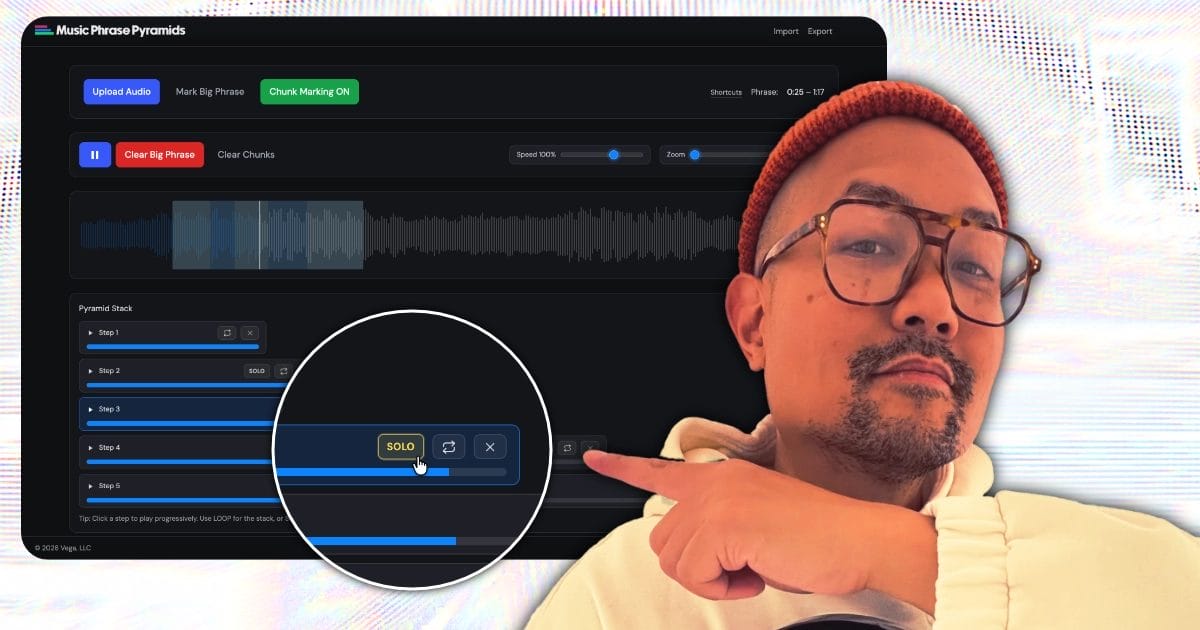
Music Phrase Pyramids - SOLO Chunk Playback UI
Music Phrase Pyramids – SOLO Chunk Playback UI

This exact challenge is what led me to add a SOLO feature inside Music Phrase Pyramids.

Not to replace progressive chunking…

But to support it.

To give you a way to:

  • briefly isolate a step
  • understand it more clearly
  • and then return right back to the full structure

Because the method still leads.

The tool just helps you stay aligned with it.

Final Thought

If you’re working on your ear, your phrasing, or your ability to actually speak through your instrument…

Remember this:

Isolation is a tool. Not a final destination.

Use it when you need it.

But always come back to the phrase.

If you want to try this approach in your own practice, I’ve built it directly into Music Phrase Pyramids.

The latest public beta (v0.3.3) includes the SOLO feature designed for exactly this workflow.

Either way,

Happy transcribing.

If you’re working on your ear, phrasing, and musical fluency, explore more in my Bass Fundamentals section—where I break down the core skills behind playing with more freedom.

Why scales don't teach improvisation

Why Scales Don’t Teach You How To Improvise (But Phrases Do)

Prev