When I taught my daughter to read at a young age, I used a technique called sentence pyramids.
Instead of showing her full sentence, I revealed it progressively: one word, then two words, then three, then four — and so on until the full sentence appears.
Each step built on the previous one.
And I even applied this applied to phonemes to teach a her how to recognize words.
The key idea was this: She didn’t memorize isolated letters. Instead, she absorbed larger chunks and phrases.
But what fascinated me most was this: I never explicitly taught her grammar. Yet she began speaking and constructing complex sentences naturally, even to the point where she could make up and tell her own stories.
And I believe it’s because she learned chunks of language more than by learning the letters individually.
My playing lacked story
For more than two decades, I’ve played the bass. During that time, I toured, played gigs, learned theory, and practiced scales, modes, arpeggios, and understood chord-scale relationships.
I’ve played cool things on the instrument and made music with some amazing musicians.
But there was always something I quietly noticed.
Some musicians, when they soloed, sounded like they were telling a story.
Their phrases had shape, direction, meaning, continuity, and contour.
And as embarrassing as it is to say, my playing often didn’t.
I had chops. My time was solid. I knew how to apply a lot of melodic concepts. But my lines lacked story.
And for the longest time, I couldn’t quite explain why. But I could at the very least intuit that telling a story musically was something far more than just applying theory.
My realization: I learned music backwards
Like many musicians, I learned music from the inside out.
I started my learning with major and pentatonic scales. Then came modes. Then chord-scale theory. And then embellishments like approach notes, enclosures, and extensions.
In other words, I learned the notes and concepts (grammar) before I learned the language (vocabulary).
And while I got pretty far this way, I eventually hit a ceiling.
Music, at its core, is a language. And humans don’t learn language by memorizing letters. We learn language through phrases.
My daughter didn’t start by studying grammar. She started by hearing and repeating meaningful chunks of sound — words, then short phrases, then longer phrases, then sentences.
Vocabulary comes before theory.
After returning to the bass from a hiatus, I spent a lot of time reflecting. And I realized: I had spent years learning musical letters… but not enough time learning musical phrases.
I learned music backwards.
Parallels between sentence pyramids and learning music
I started seeing direct parallels between reading and music learning:
| Reading | Music |
|---|---|
| letters | notes |
| words | small note groups |
| phrases | licks |
| sentences | musical lines |
| reading fluency | improvisation fluency |
Humans process language in chunks, not single units.
Cognitive science calls this chunking — grouping information into meaningful patterns to reduce cognitive load and improve retention.
That’s when it clicked:
What if I stopped transcribing notes… and started transcribing phrases?
Applying the phrase pyramid to transcribing
I immediately changed one simple thing in my practice.
Instead of pausing after every note, I:
- pressed play
- listened to the entire phrase
- paused at the phrase boundary
Then I tried to play the phrase as a unit — as a single gesture.
Accuracy wasn’t my main concern. I was more focused on the phrase itself: the rhythm, the dynamics, the articulation, the contour.
It almost always started rough. But after a few repetitions, I was playing phrases that sounded more musical than anything I had previously transcribed note-for-note.
I noticed a few things during this process:
- My melodic retention improved drastically
- I remembered phrases faster
- My fingers moved more organically. Instead of moving one note at a time or box-like patterns, they were moving in larger gestures.
- I began shaping lines instead of assembling notes
- My thinking also changed. Instead of thinking, what’s the next note? I started thinking, what’s the shape of this phrase?
- My playing began to sound more musical and more aware of contour than it ever had when I was theory-focused.
I wasn’t just finding notes anymore. I was internalizing musical language.
Where this method broke down in real practice and eventually into the idea behind my app
As powerful as this phrase-first approach was, I quickly ran into a practical problem.
Executing phrase pyramids manually was clumsy.
I had to:
- scrub audio repeatedly
- rebuild phrases in my head
- manage loops mentally
It worked — but it was very inefficient.
And the whole point of phrase learning, especially for adult musicians, is efficiency and retention.
This brought me back to the sentence pyramids thing.
If sentence pyramids helped my kid read and tell stories fluently, then musical pyramids needed a structured way to do this too.
In other words, I needed a way to turn any musical phrase into a progressive, repeatable, chunked practice stack.
Music Phrase Pyramids
So I built one.
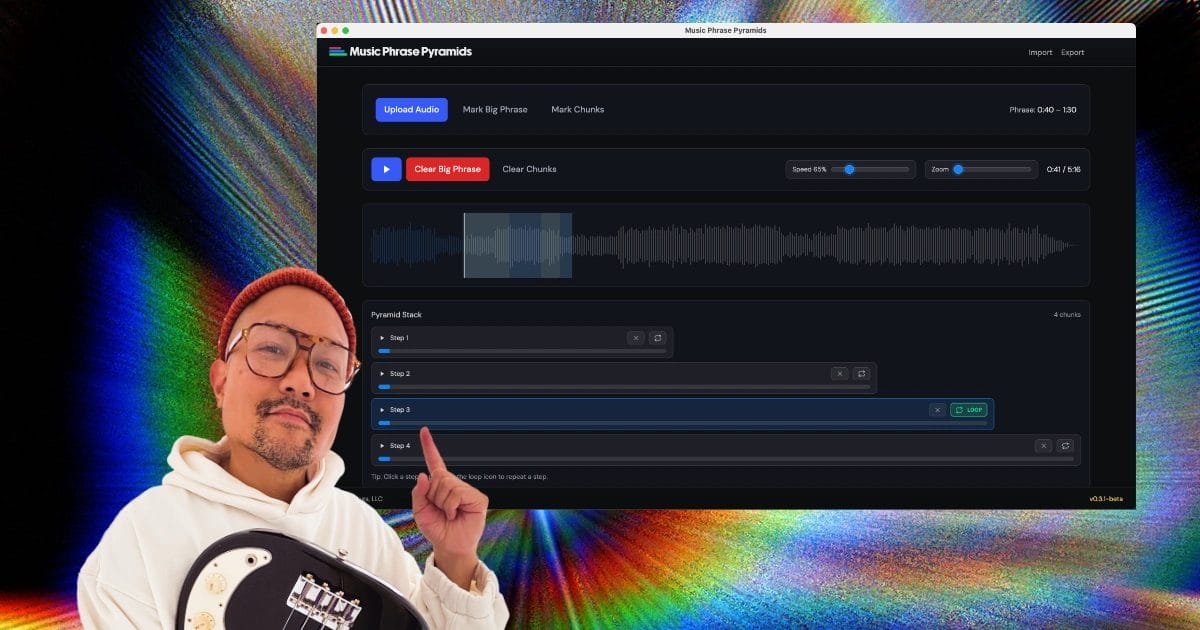
Music Phrase Pyramids is a desktop app designed around this exact way of learning by ear.
It lets you take any recorded phrase and turn it into a step-by-step practice pyramid — just like sentence pyramids in reading.
Instead of learning notes one at a time, you can:
- capture a phrase
- slice it into chunks
- rebuild it progressively
- loop each stage
- internalize the contour
In other words, it supports phrase-first transcribing and chunk-based practice in a structured, repeatable way.
Because once I experienced how powerful phrase learning was, I wanted a tool that made it easy to do consistently.
If you’re working on learning phrases, transcribing, and musical language, you’ll find more guides in my Jazz Harmony & Shapes section.
Frequently Asked Questions
How do you learn musical phrases by ear?
The most effective way to learn musical phrases by ear is to treat the phrase as a whole unit rather than a sequence of isolated notes. Instead of pausing after every note, listen to the full phrase repeatedly, internalize its rhythm and contour, and then play it as a single gesture. If needed, you can break the phrase into smaller chunks and rebuild it progressively. This phrase-first approach improves retention and helps you develop real improvisation vocabulary.
Why can I play scales but still struggle to improvise?
Scales teach you available notes, but improvisation relies on phrases. Musical fluency comes from internalizing patterns of rhythm, contour, and articulation — not just pitch collections. If you only practice scales, you’re learning musical letters without learning the language. Improvisation begins to feel natural when you absorb and reuse phrases, much like spoken language is built from remembered chunks rather than individual sounds.
Is transcribing phrases better than transcribing note-by-note?
For most musicians — especially adult learners — transcribing phrases is more effective than note-by-note transcription. Learning entire phrases reduces cognitive load, strengthens pattern recognition, and improves melodic retention. Note-by-note transcription can build accuracy, but phrase-based transcription builds musical fluency and storytelling ability, which are essential for improvisation.