


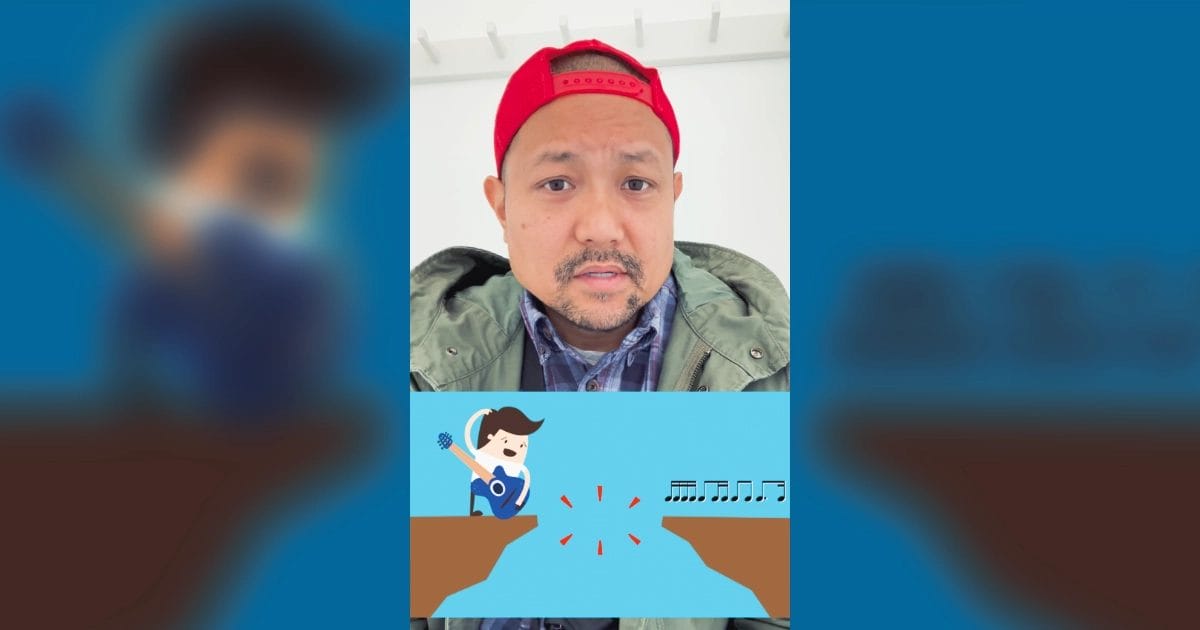

For years, I had the same frustrating experience that I think a lot of musicians have had too.
You transcribe something you love.
You spend a ton of time learning it. Getting the fingers down. Figuring out the notes. Slowing it down. Looping it over and over.
And you think you got it.
Then a few days later?
It’s gone.
You can’t even sing it anymore.
You can’t access it on your instrument.
You can’t use it in your playing.
The sound just disappears.
And here’s the thing… What I realized is that the problem wasn’t my ear.
And it wasn’t motivation either, because I was transcribing. I was putting in the work. I was constantly trying to find ways to do it more often.
The problem wasn’t even practice itself.
Because I already knew what I was supposed to do:
- learn phrases in smaller chunks
- practice them in fragments
- build them back up progressively
You’re probably already doing the same thing.
But honestly?
Even with the help of most music transcription tools, the workflow itself is harder than it needs to be.
- You’re constantly having to reselect loops.
- You’re constantly losing your place.
- You’re constantly having to manage random audio files.
The whole thing interrupts the learning process itself. And you simply don’t get in as many reps as you need to be getting in.
And this is what I came to believe:
Good practice dies in bad workflows.
Because when sounds aren’t retained, they never actually become part of your musical vocabulary.
That realization completely changed the way I thought about practicing music.
Musical Fluency Is About Access to Sound
The more I reflected on this, the more I realized something important:
Musical fluency is determined by the speed it takes for you to access sound.
You can have all the chops in the world.
You can know all the theory in the world.
But if you hear a sound and there’s still this huge gap between what you hear internally and what you can actually access on your instrument…
That gap is what I call, your fluency score.
That’s the thing we really oughta be measuring.
That’s the thing we should be trying to close.
Can you hear something internally and actually access it immediately on your instrument?
Because here’s the thing…
When sounds become accessible fast enough to use in real musical situations, that’s when they become vocabulary.
They stop disappearing a few days later.
They stop being temporary.
They stop being surface-level.
Instead, the sound becomes internalized.
And when sound becomes internalized, the gap between hearing and playing starts getting smaller and smaller.
That’s fluency.
Why I Built Music Phrase Pyramids
When I built Music Phrase Pyramids, I wanted a workflow that accomplished two things:
- Increase the frequency of transcription
- Give structure for actually internalizing sound
1. Increase the Frequency
One of the biggest barriers to transcription is friction.
A lot of transcription tools require you to already have the audio downloaded and ready to import.
But that’s not how inspiration actually happens.
I’m on TikTok.
I’m on YouTube.
I’m on Instagram.
I’m on Spotify.
I hear phrases constantly throughout the day that I want to learn.
So I wanted something that let me instantly capture audio from nearly any source.
That’s exactly what Music Phrase Pyramids does.
You can capture audio from:
- TikTok
- YouTube
- Spotify
- your microphone
- and nearly any audio source on your Mac
If you hear something inspiring, you can grab it immediately.
That alone increases the frequency of transcription dramatically.
And when friction goes down, consistency goes up.
2. Create Structure for Internalizing Sound
The second thing I needed was structure.
Because hearing something over and over again doesn’t automatically mean you’ve internalized it.
With Music Phrase Pyramids, every slice you make in the waveform creates a chunk.
Those chunks can instantly be practiced progressively in what I call a Music Phrase Pyramid.
Instead of endlessly looping the entire phrase over and over, you progressively build the phrase piece by piece:
- first chunk
- first + second
- first + second + third
- and so on
And this helps you internalize:
- the sound
- the transitions
- the phrasing
- the nuance
- the feel
Not just the notes.
And honestly, this idea didn’t even originally come from music.
It came from Sentence Pyramids — a technique often used to help children learn how to read and form sentences at a very young age. I actually learned about this from this teacher I saw on TikTok, Lisa Elaine.
This technique worked wonders for teaching my kid how to read and formulate sentences without any teaching her any grammar at first.
And I’ve been finding that this same approach works incredibly well for music too.
Because instead of just replaying sound… You’re progressively building access to it.
My First 100 Internalized Phrases
Recently, I’ve been using Music Phrase Pyramids myself while working toward my first 100 internalized phrases.
I’m mainly curating the musical vocabulary I’ve always wanted.
Because I don’t want to keep being the same musician I was 10 years ago, the same bass player that learned something cool, only to forget it a few days later.
I want sounds that stay with me and actually become a part of my musical vocabulary.
I want sounds I can actually use.
I want sounds that become part of how I naturally hear music.
Hearing Something Is Not the Same as Owning It
There are already a lot of great transcription tools out there.
But most of them focus on playback.
Music Phrase Pyramids focuses on practice structure.
Because hearing something is not the same as owning it.
And owning sound is what ultimately creates fluency.
So if you’ve ever spent hours learning phrases only to forget them a few days later… This was built for you.
You can learn more here: musicphrasepyramids.com
Explore more ideas on building musical vocabulary that actually sticks.

Put This Into Practice
If you want to actually close the gap between what you hear and what you can play, you need a way to work with real musical phrases — not just concepts.
Music Phrase Pyramids is a tool I built to help with that.
It lets you take any audio and break it into progressive steps, so you can internalize, map, and build phrases in a structured way.


