


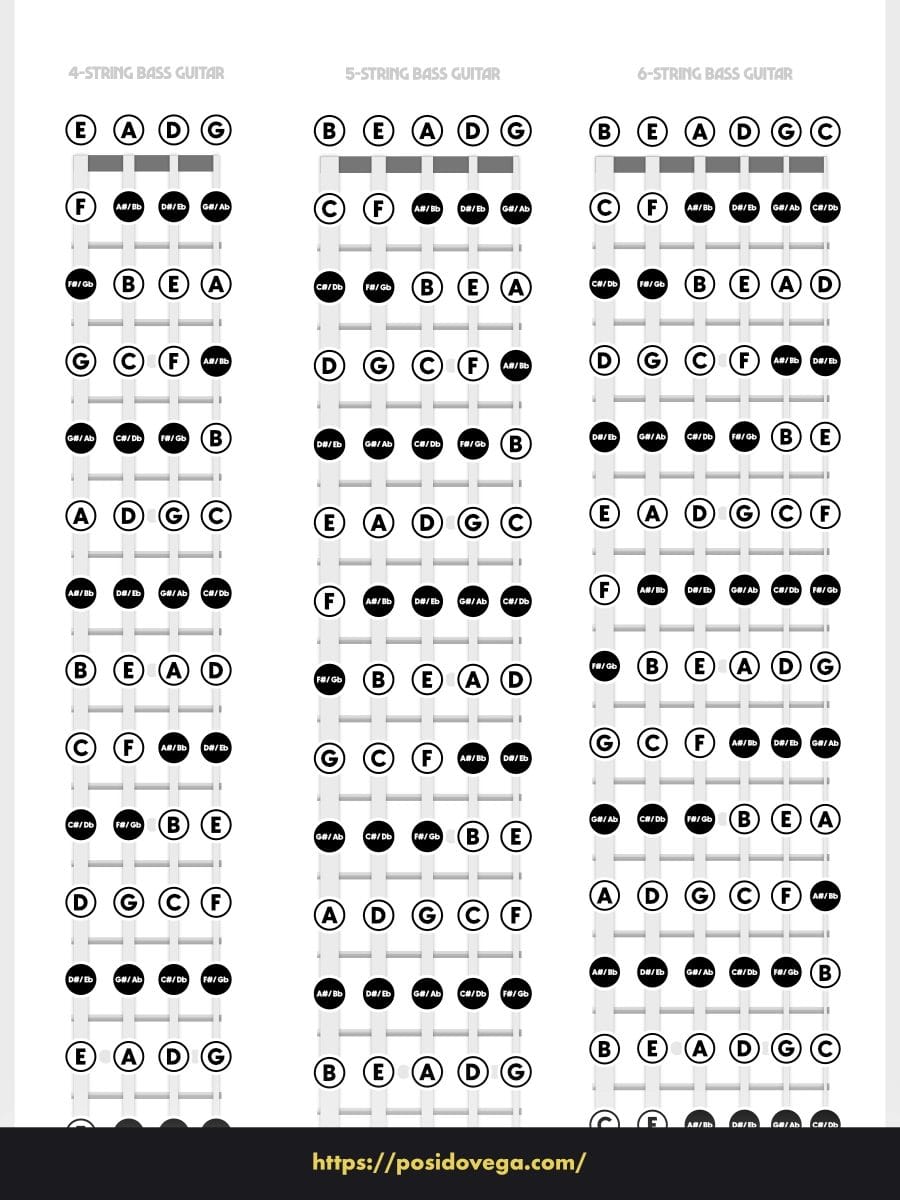

Quick Answer: A standard 4-string bass is tuned E–A–D–G from lowest to highest. A 5-string bass adds a low B: B–E–A–D–G. A 6-string bass adds a high C: B–E–A–D–G–C. The same 12 notes repeat across the fretboard every 12 frets.
4, 5, 6-String Fretboard Chart | Fretboard Note Finder Tool
I’ve been teaching the bass for more than a decade. And, I’ve found that many of my new students, even though they’ve played the bass for many years, still don’t know the location of all their bass guitar notes on their fretboard.
That shouldn’t be the case.
Learning your bass guitar notes shouldn’t take a long time. There’s a certain logic to the fretboard. When you understand that logic, everything falls into place.
In this guide, you’ll learn what the notes on a bass actually are, how they repeat across the fretboard, the fastest way to find any note quickly, and how to learn the neck without relying on brute-force memorization.
Let’s get started.
A note before we dive in: knowing where the notes are is only half the equation. The other half is being able to access them in real time — instantly, without thinking — so your ear can lead and your hands can follow. Most players have more fretboard knowledge than they realize. What they’re often missing is access speed. This guide will give you the logic to find any note on the neck. But if you find yourself knowing the notes intellectually while still feeling a delay between what you hear and what you can play, that’s a different problem — and one worth exploring further.
Fretboard Note Finder
Train your eyes to recognize notes on the bass fretboard. Pick a note, choose a string, then click the open string or fret where you think it lives.
Bass Type
Target Note
String
Challenge
What Are the Notes on a Bass Guitar? (Standard Tuning)
The notes on a bass guitar follow the same musical alphabet every instrument uses: A through G, with sharps and flats in between. What changes is the tuning and how those notes are arranged across the strings.
Here are the standard tunings for each type of bass:
- 4-string bass: E – A – D – G (low to high)
- 5-string bass: B – E – A – D – G
- 6-string bass: B – E – A – D – G – C
Every note you’ll ever play on the bass is one of these letters—repeated across the fretboard. The pattern resets every 12 frets, just like on a piano.
Once you understand this layout, the entire neck becomes easier to see, hear, and move across.
The fretboard becomes much easier when you stop thinking of it as something to memorize and start seeing it as a pattern to understand.
If you want a clear, guided system to help you learn the notes of your fretboard, check out my full bass course.
Bass Guitar Notes Chart (4-String, 5-String, and 6-String)
Above is a simple fretboard chart showing all the notes from the open strings up to the 12th fret for 4-string, 5-string, and 6-string bass guitars.
Use this chart alongside your ear. Notice where the notes repeat, where half-steps occur, and how the shapes line up across strings. These are the same patterns you’ll feel in your hands as you start learning the whole neck.
Want individual charts you can practice with? The Bass Fretboard Practice Pack includes dedicated 4-, 5-, and 6-string fretboard practice sheets that you can print out for working through the notes away from this page.
How to Read This Chart (And Why It Works)
This chart isn’t meant to overwhelm you. It’s meant to show you the logic behind the bass:
- Every fret is a half-step
- Every two frets is a whole-step
- The natural notes follow the alphabet
- E–F and B–C are always half-steps apart
- Everything repeats every 12 frets
Once you can hear and see that logic, the neck stops feeling like 20+ years of memorization and starts feeling like patterns, shapes, and musical movement.
And that’s exactly what the 4-step method below teaches.
How to Memorize the Bass Fretboard: My 4-Step Method
The approach that I used to learn every note on the fretboard can be summed up in 4 simple steps:
I’ll breakdown each step, provide some diagrams, and also provide a video explanation of my entire process.
Bookmark this page for quick reference if you’re a beginner still learning the notes on bass or just having a tough time memorizing the fretboard.
TL;DR
If you’re short on time, here’s a quick video that shows my exact approach.
Quick Practice Companions
- Warm-ups: Build a 5-minute bass warm-up routine
- Metronome: Lock your timing: practice with a metronome like a pro
- Scales Musically: Stop running scales—practice them musically
Step 1: The Interval Logic of Notes
For most styles of music, particularly Western music, there are only 12 notes that you need to learn. And, the fastest way to learn these notes is to understand the logic of how they are spelled—one note at a time.
Tip: Musical notes are spelled in alphabetical order. So, if you know your alphabet, specifically the letters A to G, you’re more than halfway there.
A, B, C, D, E, F, and G account for 7 notes. These are often called natural notes. They are also the same notes as the white keys on a piano.
This order repeats itself, no matter the instrument: A, B, C, D, E, F, G, A, B, C, D, E, F, G, etc…
The remaining 5 notes are the sharps and flats: A♯/B♭, C♯/D♭, D♯/E♭, F♯/G♭, and G♯/A♭. These are the same notes as the black keys on a piano and are located in between the natural notes.
You’ll notice that there are two ways to spell sharps and flats. This is called enharmonic spelling.
So, while a note can be the same pitch, the spelling can be different based on context. Don’t worry so much about context when you’re starting out. Once you master your fretboard, learning which spelling to use, and when, will come naturally.
Whole-Steps and Half-Steps
You’ll notice on a piano that there are black keys in between each white key, except for two places.
Tip: There’s no black key between the notes E and F. And, there is no black key between the notes B and C. This logic is the same on a fretboard, whether it’s a bass fretboard or a guitar fretboard!
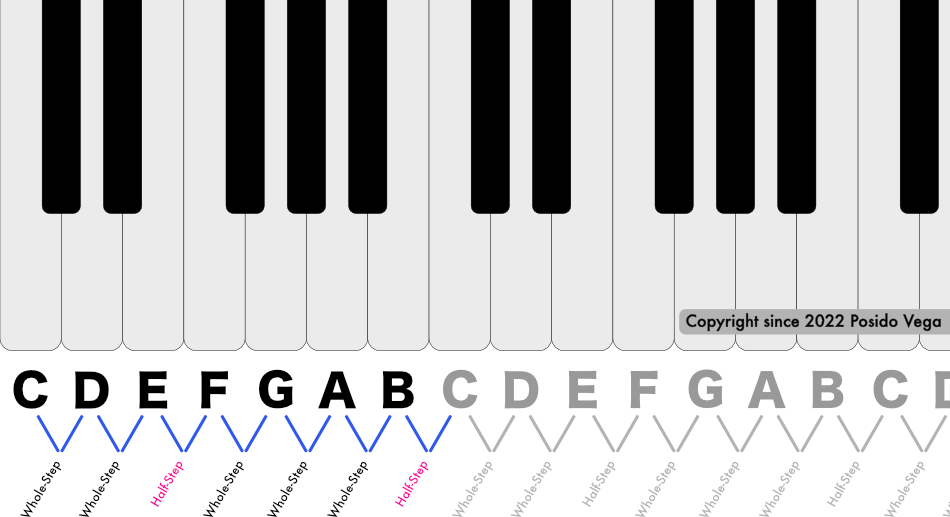
The notes E and F are always a half-step apart (one fret). And, the notes B and C are always a half-step apart (one fret).
All the other notes are a whole-step apart (two frets).
Next up, let’s immediately apply this to our fretboard. The approach I’ll show you is much less tedious than memorizing notes chromatically.
Turn Note Logic Into Musical Vocabulary
- Pentatonics: Pentatonic shapes for instant, musical lines
- Guide Tones: Guide tones: the notes that make lines sound intentional
Step 2: The Logic of the Bass Guitar Fretboard
Previously, we learned that:
- musical notes are spelled in alphabetical order
- the notes E-F and B-C are always a half-step apart
- and all other natural notes are a whole-step (2-frets) apart.
Here’s the most important logic of the fretboard that you must know:
- Each fret on your fingerboard is a half-step.
- Two frets is a whole-step.
On a four-string bass guitar, your open string notes are E, A, D, and G.

Let’s focus on your lowest string, the E string. The easiest way to learn your bass guitar notes is to start with one string.
Remember, the notes E-F and B-C are the only notes that don’t have any notes in between.
Find The Notes of Your E-String (The Easy Way)
So, on your E-string, the first fret is the note F.
Following the same logic of musical notes will reveal the location of all your natural notes on your E string:
- Two frets up from F is G.
- Two frets up from G is A.
- Two frets up from A is B.
- One fret up from B is C.
- Two frets up from C is D.
- Two frets up from D is E.
- Then this pattern repeats itself.
Let’s apply what you just learned to the next string, the A-string.
Find The Notes of Your A-String (The Easy Way)
The note locations on the A-string, are:
- Two frets up from A is B.
- One fret up from B is C.
- Two frets up from C is D.
- Two frets up from D is E.
- One fret up from E is F.
- Two frets up from F is G.
- Two frets up from G is A.
- This pattern also repeats itself.
Let’s keep going and learn the locations of natural notes on the D-string.
Find The Notes of Your D-String (The Easy Way)
The note locations on the D-string, are:
- Two frets up from D is E.
- One fret up from E is F.
- Two frets up from F is G.
- Two frets up from G is A.
- Two frets up from A is B.
- One fret up from B is C.
- Two frets up from C is D.
- This pattern also repeats itself.
One more string to go! Let’s learn our bass guitar notes on the G-string.
Find The Notes of Your G-String (The Easy Way)
The note locations on the G-string, are:
- Two frets up from G is A.
- Two frets up from A is B.
- One fret up from B is C.
- Two frets up from C is D.
- Two frets up from D is E.
- One fret up from E is F.
- Two frets up from F is G.
- This pattern also repeats itself.
Now, let’s ramp things up and start learning our octaves!
Build Harmony From Your Map
- Arpeggios: Arpeggios: the fastest path from notes to music
- Beginner Bass Chords: Beginner bass chords: practical shapes that sit in the mix
- Drop-2: Drop-2 voicings for lush, playable harmony
Step 3: The Locations of Octaves
This next step is crucial to accelerating your knowledge of the fretboard. Octaves serve as signposts on the fretboard. Actually any interval, such as a 5th, can serve as a signpost. But, I recommend learning octaves for all beginner bass players, because they’re the same exact note and confuse less.
A perfect octave is the same note name, but at a different register.
The register can be either higher or lower.
To keep things simple, there are many octaves on your bass guitar fretboard. And you’ll want to learn where they all are.
Find all of them along the neck of the bass.
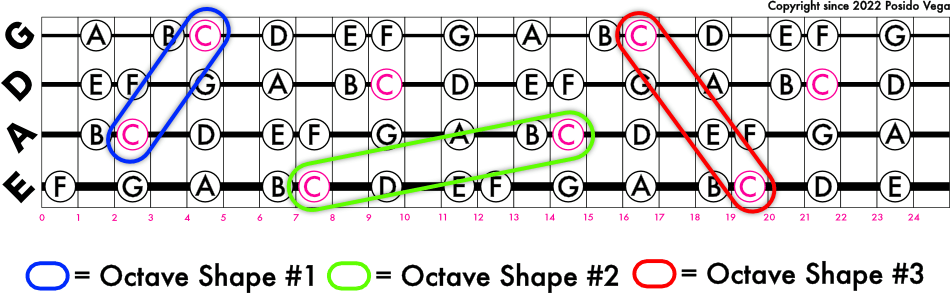
Here are a few easy to remember octave shapes:
- Two frets higher and two strings higher is one octave higher.
- Two frets lower and two strings lower is one octave lower.
- Three frets lower and three strings higher is one octave higher.
- Three frets higher and three strings lower is one octave lower.
- Seven frets higher and one string higher is one octave higher.
- Seven frets lower and one string lower is one octave lower.
Quick note: Five frets lower and one string higher, or five frets higher and one string lower, takes you to the same pitch in the same octave. These are unison shapes and useful for navigating your fretboard.

Imagine your fretboard finally making sense.
A clear, intuitive system that removes the guesswork.
Step 4: Apply To All Musical Situations (Learn Your Fretboard Fast!)
You can learn the notes of your bass with the first 3 steps. But, it’s step 4, applying logic and using the octave as a signpost, that’ll get you learning your notes fast.
Tip: There’s no way around this. You have to play your bass. And, you have to exercise applying what you know.
The more you do it, the more the notes will become second nature and you’ll master the fretboard sooner than you realize.
In this video, I’ll show you how to apply the stuff you just learned, using a simple bass line and a metronome to keep time. While playing the root note, I’ll often think about where the octave is and then play the same bassline an octave up.
You’ll see just how easy it is to find the notes on your fretboard.
(Bonus) Step 5: Say the note name aloud as much as you can
Each time you practice, I recommend spending a few minutes consciously saying the name of each note out loud.
Practice this slowly.
You’re aiming for accuracy over speed.
This is a very helpful way to learn all the notes on a bass in a short period of time. And, something I used to do often is say the name, locate the fret, then go for the note. When I was learning to read standard music notation, I’d often say the note spellings out loud to reinforce the locations on my fretboard.
I would do this during band practice, jams, and even in live performances. That way I’m learning while playing in time.
This forced me to think on the fly. It was also a good confidence booster when I was first starting on the bass.
Stop Guessing What Note You’re On.
So you can play freely, confidently, and without overthinking.
Now it’s your turn
All this knowledge about logic and octaves is great. But, it’ll be much better when you start putting it into practice.
Learning your bass guitar notes is essential if you want to be able to improvise, read music, or play along to a chord chart (while keeping time).
So, start applying what you just learned and you’ll see progress in a matter of weeks.
Want to go deeper into fretboard fluency? Explore the full Fretboard & Notes hub and start building real confidence across the entire neck.
And remember: Once you know where the notes are, the next challenge is accessing musical ideas quickly. That’s where building a vocabulary of musical phrases becomes far more useful than memorizing isolated notes.
- How to Build a Vocabulary of Musical Phrases
- Why Some Musicians Sound Fluent
- The Great Bass Vocabulary Project
Frequently Asked Questions
What are the notes on a bass? (Standard Tuning)
The bass is tuned in fourths for standard tuning.
In standard tuning, a 4-string bass is tuned E – A – D – G, from lowest to highest. These four notes repeat every 12 frets across the neck.
In standard tuning, a 5-string bass is tuned B – E – A – D – G, from lowest to highest. These five notes repeat every 12 frets across the neck.
In standard tuning, a 6-string bass is tuned B – E – A – D – G – C, from lowest to highest. These six notes repeat every 12 frets across the neck.
What’s the best way to memorize bass guitar notes?
The fastest way to memorize the notes on a bass guitar is to understand the logic of the fretboard — not brute-force memorization. Learn how whole-steps and half-steps work, find your octave shapes, and name the notes out loud as you play. When the logic is clear, the memorization happens naturally.
How To Find Notes On Bass Guitar?
Start by learning the open strings (E, A, D, G). Each fret is a half-step, so moving one fret changes the note by one semitone. Following the musical alphabet (A–G) and knowing where the half-steps are (E–F and B–C) lets you find any note quickly on any string.
Are bass notes the same as guitar notes?
Yes. Bass and guitar use the exact same 12 musical notes — A through G, with sharps and flats in between. The difference is tuning and range: the bass is tuned lower and usually has fewer strings. Guitar tuning also shifts slightly at the top, with the G and B strings tuned a major third apart instead of a fourth.

Reduce Mental Friction
You already know more than you can access in the moment.
Shape to Statement helps you turn the theory, shapes, and vocabulary you already know into musical ideas you can access in real time.


